Showing posts with label BMW. Show all posts

BMW Alpina B7 gets power boost for 2013

6/17/2012

Base price also gets a boost to $128,495
The 2013 BMW Alpina B7, the performance version of the German automaker's 7-series sedan, gets an additional 40 hp--and a more costly sticker price--for the new model year.

BMW plans to roll out the 2013 model at the Pebble Beach Concours d'Elegance in August and begin sales soon thereafter.

Under the hood, power from the 4.4-liter V8 has been increased from 500 to 540 hp with the addition of BMW's throttle-less Valvetronic intake system. Torque rises to 538 lb-ft from 516 lb-ft.

The powertrain also gets a new eight-speed automatic from Alpina. BMW says the Alpina B7's top speed is limited to 194 mph by aerodynamic drag. You can equip the Alpina B7 with BMW's xDrive all-wheel-drive system.

The Alpina B7 will also put a slight drain on your bank account. Prices start at $128,495 for a standard-wheelbase B7 and run all the way up to $135,395 for a long-wheelbase model with xDrive. All prices include shipping charges.

Check out the full press release below for all the details:

The 2013 BMW ALPINA B7 super-high performance luxury sedan with enhanced features, efficiency, and individuality for discriminating customers.

Woodcliff Lake, NJ – June 15, 2012…. Today, BMW announced updates to the second generation of the successful BMW ALPINA B7 super-high performance luxury sedan with more performance, fresh design features, and improved efficiency. The new B7 is slated for a North American debut at the historic Pebble Beach Concours d'Elegance in August and will go on-sale immediately thereafter. Pricing will be $127,600 (B7 Standard Wheelbase), $130,600 (B7 SWB with xDrive), $131,500 (B7 Long Wheelbase), and $134,500 (B7 LWB with xDrive).

The new BMW ALPINA B7 has been enhanced in-line with updates to the 2013 BMW 7 Series Sedans including more power, more performance, and more efficiency. The new B7 features 40 additional horsepower (now rated 540 hp) and 22 lb-ft more torque (up to 538 from 516 lb-ft) thanks to the addition of BMW's Valvetronic throttle-less intake technology and a new ALPINA 8- speed high performance transmission. Top speed is now a fierce 194 mph (drag-limited, 193 mph with xDrive), up from the previous 175 mph. Acceleration drops into the low-mid-4-second range for all variants (4.3-4.4 seconds). The BMW ALPINA B7 Sedan remains the benchmark in terms of luxurious performance, chassis technology, and hand-finished exclusivity.

Each variant of the updated BMW ALPINA B7 (including Standard Wheelbase, Long Wheelbase, sDrive, and xDrive) will arrive with over 30 new parts which enhance the design and frontal aerodynamics to more effectively channel the cooling air required to manage the increased power output. New BMW kidney grilles, updated Xenon Adaptive headlights, LED front fog lights, and updated tail lights are also included. Other now-standard features will include ceramic secondary controls, engine Automatic Start-Stop, and the Active protection system. Optionally, the B7 Sedan will offer Full LED Headlights, Bang & Olufsen Surround Sound System, new exterior colors and interior upholstery choices in-line with the 7 Series update. Renewed BMW individual color and trim offerings complete the package. The appearance remains unmistakable on signature 21” ALPINA Classic 20-spoke wheels and stunning ALPINA Blue Metallic paint.

The BMW ALPINA B7 is available as a special order vehicle with capacity-limited production underscoring its exclusivity. The B7's body is manufactured in the BMW 7 Series factory (Plant Dingolfing) and hand-finished with the remaining ALPINA components at the ALPINA factory in Buchloe, Germany. This production sequence increases the production schedule by approximately two weeks. European Delivery at the BMW Welt delivery center is available for the BMW ALPINA B7.

Gallery :


BMW to debut FWD 1-Series GT in Paris?

6/11/2012

Underground Racing has ripped the covers off its custom tuned 2012 Lamborghini Aventador LP700-4 Twin Turbo. The highly modded version of Lamborghini’s fastest ever production scorches from 0-60 in an F1-quick 2.2 seconds.
The North Carolina-based tuning house has bolted on two turbochargers to the Italian icon’s already ballistic supercar and in doing so, launches it into the stratosphere as one of the few cars producing in excess of 1000hp. In standard trim, the $379k Aventador accelerates from 0-60 in just 2.9 seconds, with the performance enhancements cutting another 7 tenths off its sprint time.

It pulls off its remarkable acceleration time shod in OEM street tires, normal air pressure and on a regular road. However, it does require a full engine rebuild of Lamborghini’s 12-cyclinder masterpiece. Aside from the engine rework, Underground Racing also fitted a custom Quickshift upgrade to take full advantage of the additional horses on offer.
“It seems that the factory really tried to make it hard for the aftermarket world to modify the Aventadors though,” reads a statement from the company. “However, the Underground Racing team moved quickly through the road blocks that exist. For now, the UR TT Aventadors will only be released with FULL engine builds. Through our research, we have found certain conditions that make this a requirement.”
At the time of writing, Underground Racing has yet to publish the full specifications or exact pricing of the upgrade. Underground Racing performance upgrades of this nature typically cost around $100k for parts and labor. Worth it, if you’ve got the cash we think.

BMW to debut FWD 1-Series GT in Paris?

For numerous decades it was nearly impossible to imagine a front-wheel drive BMW. It was like trying to fathom a rear-drive Saab, or a rear-drive Citroën, it just couldn’t be done because it went against the brand’s core principles. Even as a vast majority of the auto industry progressively left rear-wheel drive behind, BMW stood its ground and refused to yield an inch.

Rivals Mercedes-Benz and Audi both offer front-wheel drive in their entry-level models and BMW has gained a fair share of expertise in the field with its highly-profitable MINI brand so it was only a matter of time before the Munich-based automaker caved in.

England’s Autocar reports that BMW is currently developing an all-new front-wheel drive model that will likely wear the name 1-Series GT. The magazine’s sources say that it will debut as a thinly-disguised concept at the Paris Motor Show next fall.

The 1-Series GT will ride on the same newly-developed UKL platform as the next-generation MINI hatchback. It will be taller than both the MINI and the standard rear-drive 1-Series and it will compete in the same arena as the Mercedes-Benz B-Class.

Powering the 1-Series GT’s front wheels will be an all-new 1.5-liter three-cylinder gasoline engine that is essentially a 3.0 straight-six that has been chopped in half. The car will also be available with four-cylinder gas engines as well as several turbodiesels, but don’t expect to see a performance-oriented M version of it.

Although purists will undoubtedly gawk at the idea of a front-wheel drive BMW, the 1-Series GT’s target audience is not expected to have an issue with the new layout. In fact, in a study conducted in 2010 BMW found that 80 percent of 1-Series owners were convinced that the car was front-wheel drive.

BMW looks to patent seven-speed lockout manual transmission

6/09/2012

e90post.com
BMW is looking to patent a seven-speed manual transmission.
The intrepid Bimmerphiles over at www.e90post.com have uncovered a few drawings from BMW's latest patent request. The drawing shows a new transmission linkage and what looks to be a seven-speed manual transmission.

Like the new Porsche 911, the BMW gear shifter has six gears in standard H pattern, with a seventh gear out to the right. We'd guess that the last gear would be a cruising cog for better fuel mileage on the highway.

The company is also exploring a way to protect drivers from hitting the wrong gear during spirited gear changes by using magnetorheologic fluid--the same fluid that General Motors and others use for fast-changing suspensions in high-performance sports cars. The fluid would thicken up with an electric charge, locking out gates of gears that shouldn't be selected. Both the shifter look and the lockout function are illustrated in the patent drawings.

The other option the company looks to be exploring is a clutchless, shift-by-wire option. That would let drivers bang through the gears without a third pedal, while being protected from going into first gear at 70 mph. All of this will be controlled by the computer and take place in fractions of a second.

First Drive: 2012 BMW 640i Gran Coupe [Review]

6/06/2012

You’re not alone in thinking that a coupe is a two-door vehicle, but the niche-loving Germans have sought to reinvent the wheel once again. Jumping into the fray is BMW with their new 2013 640i Gran Coupe. 

Is the horse out of the barn, or is the Bavarian auto company really on to something, with their latest entry to the segment? Hop in with us as we take a first drive in BMW’s latest niche-buster. 

Don’t confuse this car with the disappointing 5-Series GT five-door crossover. The Gran Coupe is a completely different animal. The object is that if you squint enough when peering at the Gran Coupe, that the second set of doors will blend in to the point that they are invisible. As a segment, this group is also home to the Audi A7, Porsche Panamera and Mercedes–Benz CLS, the latter of which started the concept of a four-door coupe back in 2005. 

New kid on the block
Not a new concept, the 640i Gran Coupe is what the brand calls a 4+1 seater. It’s just that we would not want to be that +1. Offered three variants, the new 6-Series Gran Coupe expands the 6-Series’ overall portfolio and will first hit the streets as the 640i seen here, with motivation coming from the TwinPower Turbo inline six-cylinder engine. Similar to the N55 engine found in the 335i, this mill produces 315 horsepower between 5,400-6,000 rpm and 330 lb-ft of torque between 1,400-5,400 rpm. BMW says to expect 0 to 60 times of 5.4-seconds and top speed is electronically governed to 155 mph. 

The 650i Gran Coupe and 650i xDrive (all-wheel-drive) Gran Coupe will follow in late summer. Power for the 650i will come from an N63 4.4-liter Twin Turbo reverse-flow V8 that produces 445 horsepower between 5,500-6,400 rpm and 480 lb-ft of torque. The same engine, when used in the 650i xDrive will yield 400 horsepower between 5,500-6,400 rpm and 450 lb-ft of torque. They manage to tick off 0-60 times of 4.5 and 4.3-seconds, respectively. 

All three flavors are mated to eight–speed automatic transmissions to maximize fuel economy at barely breathing revs. Extra efficiency comes by way of the BMW Efficient Dynamics protocol that utilizes brake energy regeneration, engine auto start-stop and on-demand operation of ancillary components such as air conditioning and electrical loads during the time you are driving versus idling. With the I-6, the firm estimates fuel economy to arrive at a respectable 20/30 mpg, with a 24 mpg average. 

The 640i’s ride quality is decidedly sporty. Comprised of a double wishbone front suspension and a multi-link kit in the rear, it is also equipped with BMW’s dynamic damper control, which adapts to the road surfaces and driving styles of whoever is behind the wheel. We found through the control on the center console, that we could change the driving characteristics from Comfort to Comfort +, Sport and Sport+ modes with the flick of a switch. The engineers for Munich claim that the system works as quickly as 2.5 milliseconds. 

The electrical power-assisted Servotronic speed–sensitive steering system offered typical BMW–style road feel that we have come to expect from this so-called ultimate driving machine. It was adept at handling California’s Highway 33 with its twisties and winding canyon roads as it was at handling the grooved pavement on Highway 101. For those seeking more, the Gran Coupe can be had with Integral Active Steering, which combines the front’s active steering system with a steerable rear setup at the back. The net result of this package shortens (or lengthens) the Gran Coupe’s wheelbase for better high-speed stability and slow speed parking maneuvers. Although our tester was not so-equipped, we have tried the identical system on current 6-Series vehicles and can attest that it works as advertised. 

Looks matter
Although it’s obvious that the Gran Coupe and 6-Series share many identical parts, the one thing they don’t share is a wheelbase and overall length. The Gran Coupe has an overall measurement of 197.2-inches, which is 4.2-inches more than the standard two–door version. At the same time, the four–door has a wheelbase of 116.9-inches, which is 4.7-inches longer than its big brother. It also shares similar lower valances with those seen on the two-door version. 

What do you get with all that extra room? Well, for starters, how about two additional doors? Within the new pair are two outboard seats that can comfortably handle a pair of adults. Sure, the addition of only one inch of headroom might feel claustrophobic to some, but it’s nothing like having to sit in the center position astride the transmission tunnel. That’s why we are content to call this car a four seater. Interesting little details abound, including the Gran Coupe logo that resides under the glass, just behind the trademark Hofmeister Kink. 

The overall effect of the greenhouse is a successful execution of trompe l’oeil, which does, in-fact, impart the impression of a fastback two-door coupe. But that’s not to say that it has the same effect as seen, for example, on the Aston Martin Rapide or the Mercedes-Benz CLS. It’s not better or worse by any stretch of the imagination. Just different. 

Coddling to do
Purchasers in this segment love to be coddled. To that end, the 640i Gran Sport does not disappoint. The driver’s side of the cabin starts off with an M–Sport equipped cockpit that includes a leather–wrapped three point steering wheel with alloy paddle shifters, an M–Sport dead pedal and customizable TFT LCD screen and head up display. Once again, we had difficulty seeing the head up display while wearing polarized sunglasses. 

Fine wood veneers offer a contrast to the two–toned single needle stitched leather dash area with its 10.2-inch iDrive controller display. 

On the comfort side, highly adjustable bolstered driving seats held us firmly in place while cutting the apexes on the twisty canyon roads of 33. The rear seats, while not as bolstered, did manage to supply a comfortable ride with sufficient legroom for your favorite backseat drivers. They are foldable in a 60:40 split. The two front seats feature integrated seatbelt retractors, just as those found on the seats of the 6-Series Coupe. 

Motion sensors
Our introduction to the 640i Gran Coupe showed us a capable four-door sports car that truly did not need the added oomph of a big V8. The 315 horsepower and 330 lb-ft of twist from the three-liter TwinPower Turbo six-cyl is truly an impressive piece of motivating force. That becomes even more evident when you consider that it’s moving a 4,200 lbs. sled up and down varying degrees of road grade, through mountain passes and tightly-coiled switchbacks. 

The Driving Dynamics Control offered the right type of stability and comfort for the drive at hand. The twists and turns on Pistachio Road call for a firm ride with lack of roll to help keep the four tires firmly planted. Able to help settle the car quicker, we were ready for the quick reverse that generally awaited us on the other side of a blind turn. Conversely, the comfort setting virtually made the expansion joints and grooved surfaces of the major highways disappear. 

Those who think that only bigger is better – and have the wallet to back that up – can wait until the end of summer for the V8-powered 650i and 650i xDrive Gran Coupe models. 

Leftlane’s bottom line
Definitely not a substitution for the 7-Series, BMW’s new four-door sports coupe offers a multitude of options for a driver to choose how he wants to control his vehicle. 

From a quad that thinks it’s a deuce, to a sporting corner cutter, all the way to a debutante delivery vehicle, the new 640i Gran Coupe tries to span a wide variety of segments – and it mostly succeeds.
2012 BMW 640i Gran Coupe base price, $76,895. 

Gallery :


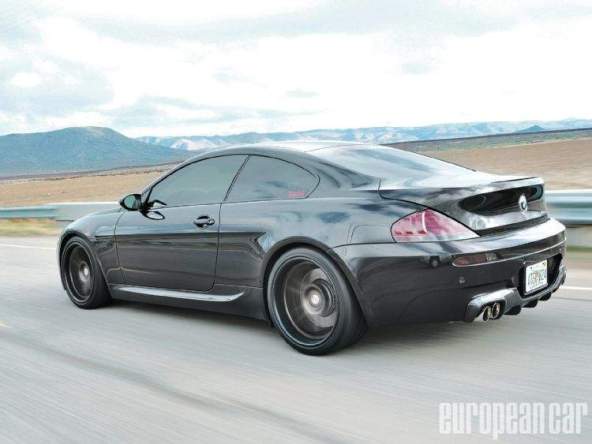
2007 BMW M6 - Black Ops

6/03/2012


I hated to do it because it went against my competitive instincts, but I stuck my hand out the window to motion the red, turbocharged E46 M3 past me on the left after the long-ish back straight on the Streets of Willow. I was holding him up because the Hoosier race tires still weren’t up to temp on that crisp winter day up in the high desert, and the car was sliding around too much. After tailing him for a lap at a gap of five to six car lengths, I felt the tires starting to come into their own, which meant it was time to try to redeem myself.

 
The M6 I was driving was fortified with ESS Tuning’s new supercharger system, so new that the kit hadn’t been officially released at that point. The ESS engineers spent two years developing the system, with a lot of cold-weather testing in Scandinavia and countless hours of hard running on the Nürburgring and the autobahn. For the final stages, more tests were carried out at their Arizona test facilities to make sure it would run properly in hot weather as well. The two-year, unlimited-mileage warranty shows they have faith in it. 
 
With the tires warmed up, I started to find spots where I would gain on the M3; a little bit through the fast esses and then some more on the two fast straights. Where I was losing time was coming out of the slow, Second-gear corners. The supercharger’s immediate onslaught of torque would spin the tires as if they were wrapped with bacon and the M3 would stretch its lead. Finding that fine line just before the tires started to spin called for judicious throttle inputs, and when I got it right, I could sense that I was clawing back the distance lost, inch by inch.

I had seen the red M3 in the parking lot earlier in the day and noticed it packed a Horsepower Freaks (HPF) turbocharger system. Some of their systems can crank out as much as 789 hp on pump gas. Their baseline, Stage 1 kits are rated at 518 hp. So as I tried to reel him in, I figured he probably had the advantage in terms of power-to-weight and the M6 had the advantage over him in the grip department what with the M6 on R-compound Hoosiers and the M3 using the widest street tires that the owner could stuff in the wheelwells.

Seeing the gap close gave me the confidence to push even harder; a little later on the brakes here or full throttle through the uphill blind kink on the back straight or letting the nose slide out just a little at the end of the fast, downhill, Third-gear left-hander. The M6 was more than willing, although the stock brakes and pads were its weakest link. I had expected it to feel fat and out of shape on the track but its composure surprised me. You could tell it was a heavyweight, but it moved around the ring like a middleweight. Eibach Pro springs were the only suspension changes and you could feel them being worked but not overwhelmed. The R6 Hoosiers (265/30-19 (f) and 295/30-19 (r)) relayed plenty of info through the steering wheel, with the front tires giving up first and power oversteer practically any time you wanted it—and sometimes when you didn’t.

The power was good at almost any point in the rev range. Sill present was the lack of low-end torque the S85 engine has taken criticism for, but on the track where you’re playing with the serious half of the rev range, the ESS supercharger noticeably fattens up the mid-range, making that surge towards the engine’s ridiculous 8250-rpm redline come that much quicker with the smoothness, force and propulsion of a jet turbine. The delivery is seamless and the only telltale sign that the engine is not stock is the muffled whistling sound from the spooling blower.


The ESS kit is based around a Vortech V3Si supercharger; a cast-aluminum manifold; high-flow Bosch Motorsport fuel injectors; a cast, high-temperature plastic intake for the supercharger; a reprogrammed ECU with new settings for the VANOS and throttle sensor and the assorted brackets, belts and hoses. Their VT-1 kit, which the M6 was running, is rated at 625 hp and 455 lb-ft of torque compared to 500 hp and 380 lb-ft stock. Maximum boost is 5.5 psi. Their VT-2 kit includes an intercooler, a smaller pulley and an ECU tune to accommodate the upgrades for a 25-hp bump to 650 hp at 7 psi.


The way I reeled in the M3 over the course of four or five laps made me think that maybe there wasn’t a power-to-weight advantage because now I can read when the registration on his license plate expires. Maybe his tires are starting to overheat or his brakes were cooked or maybe there’s more than one reason I’m on his tail and actually holding back in some sections. Whatever the reason, I’ll take it. On the same section I let him by a few laps ago, he stuck out his hand and told me to pass him on the left.

Off the track and on the street the ESS supercharger exhibited the same seamless delivery of power, with quick, effortless blasts up to 130 and tons more pull beyond that.

There were, however, times when I had to drop down an extra gear to make real progress. The fact is it’s still a 3,900-pound car and that 455 lb-ft of torque isn’t around at 2000 or 3000 rpm. ESS also offers a reprogram of the SMG’s brain for crisper, faster shifts so getting the car to scoot just takes a nudge on the paddle.

Aesthetically, the car features Vorsteiner’s carbon front lip and rear diffuser, from which the exhaust tips of an RPI full cat-back exhaust protrude. The grille has been matted black and the side grilles have a subtle matte bronze finish to match the center spokes of the HRE 794RS wheels (9.5x20 (f), 11x20 (r)). Those wheels are bound by Pirelli P-Zero Corsas measuring 265/30 front and 295/30 rear. The headlight covers have been tinted to finish off its sinister presence.

2007 BMW M6

Layout
Longitudinal front engine, rear-wheel drive

Engine
5.0-liter V10, dohc, 40-valve. ESS Tuning VT-1 supercharger, RPI full cat-back exhaust

Transmission
SMG III, seven-speed semi-automatic with ESS Tuning software

Suspension
Eibach ProKit springs

Wheels and Tires
HRE 794RS (9.5x20 (f), 11x20 (r) (street)
Pirelli P-Zero Corsa 265/30 (f), 295/30 (r) (street)
Stock M6 9.5x19 (track)
Hoosier R6 265/30 (f), 295/30 (r) (track)

Performance
Peak Power: 625 hp
Peak Torque: 455 lb-ft

First Drive: 2012 BMW M6 Convertible

6/02/2012

It was though they knew we were coming. A string of shiny-and matte-finished 2012 BMW M6 convertibles on their way from Santa Barbara to CA-33, also affectionately known as the Pistachio Road, had the California Highway Patrol (CHiPs) quickly trying to fill in the holes of the Golden State’s budget deficit. 

We at Leftlane managed to escape with our wallets intact. The same can’t be said for some of our motoring brethren. 

But a day behind the wheel of BMW’s new uber-grand tourer is worth the stress. Now where did I leave my Valentine 1? (The next best thing to a diplomatic passport.) 

I’M6 back
Now in its third generation, the M6, available as both a coupe and in the case of our test car, a convertible, makes its first appearance in over two years. The convertible will arrive in dealer showrooms in June 2012 as a short run 2012 model, while the coupe will arrive in late summer as a 2013 offering. Not for the faint of wallet, the entry to this club starts with a base price of $113,995, which includes an $895 destination fee. Pluckiness on the part of your local dealer may push the price further north. 

The basis for the M6 Convertible is the famously received BMW 6-Series convertible. Long a favorite of the coastal sunbelt set, BMW will only say that it “slightly “beats the coupe in sales numbers. Incidentally, buyers on the old continent aren’t much for convertibles, as the U.S. is the main market for those who prefer to go topless. 

Eschewing the 5.0-liter V10 engine that powered the previous M5 and M6 models, the new M6 draws its motivation from the 4.4-liter M TwinPower Turbo Technology (whew!) V8 first seen in the X5M and X6M high-performance crossovers. Using a design known internally as S63Tü, this direct-injection engine makes 560-horsepower at 5,750-7,000 rpm. Twist, in the form of 500 lb-ft comes on at 1,500 and continues up through 5,750 rpm. BMW is claiming that the power is 10 percent higher and torque is now upwards of 30 percent greater than found in the previous V10. The added oomph presents a power band that is almost three times as wide as that found in the larger package. 

Using a reverse–flow protocol, BMW has placed the fuel delivery systems on the outsides of the cylinders while the twin turbochargers rest in the valley between cylinder heads. As seen in the X6M, it allows for a much more compact package under hood. This, combined with a cross–bank exhaust manifold and other features help to nearly eliminate turbo lag that is usually found in more conventional systems.

With the previous M6, owners would dial-in the full 505 horsepower using the BMW iDrive controller. It was a wink and a nod manner that enabled the company to skirt a few environmental regulations and allowed the vehicle’s individual owners a chance to up the power on their own. Think of it as power-chipping on demand. Except with the new V8 engine, such sleight-of-hand is no longer required. Instead, owners can achieve EPA estimates of 14/20 mpg, with a combined 16 mpg between fill-ups. 

Power gets to the pavement through a seven–speed M-Double Clutch transmission with BMW’sDrivelogic. Able to function as an automatic (D) or a clutch pedal–less manual (S) transmission, it is controlled either by a sequential shift function of the shift lever or by steering wheel-mounted paddle shift levers. Regardless, shifting occurs with a satisfying pop that supplies an emotional high while tapping through the gears. 

The Drivelogic portion of the gearbox tailors selection according to the drive style. D1 is for basic driving, followed by D2 for laid back cruising. D3 is more performance oriented, and we found it typically holds gears longer until the revs climb to a sufficient rate of speed. Conversely, S1 offers standard gear changes while S2 offers the gear pops we mentioned above. S3 is optimum for track usage and enables a launch control function. 

BMW’s version of electro-hydraulic dampers finds its way into the kit of the M6. Using what the company calls, Dynamic Damper Control, the M6 tailors its ride quality to the driver’s wish. Available in three modes, ranging from Comfort to Sport to Sport Plus, the ride can go from plush to ultra firm with the touch of a button. The same parameters can be dialed in for steering as well. 

An adjustable M-specific suspension kit is also part of this package and includes a rear axle subframe and dynamically mounted axles with specially tuned axle kinematics make for a suspension that BMW claims is actually faster than its engine. 

Speaking of fast, the M6 Convertible will sprint from 0-60 mph in just 4.2 seconds before topping out at an electronically-limited 155 mph. 

Interior decorating
Decidedly avant-garde in design, the interior is well equipped with new, modern looks including M6-specific leather seats with adjustable bolsters and thigh supports. Active head restraints are along for the ride as a deterrent to whiplash. The haute theme continues throughout the cockpit with leather trim and carbon fiber panels on the dashboard and door panels. 

A pair of rear seats is on offer, although they aren’t habitable for very long. The passenger seat can move forward to offer a bit of legroom, but occupants behind the driver may not be as lucky. 

The 10.2-inch LCD display is in place for operation of the iDrive controls that manipulate the climate, Bluetooth, navigation and audio systems. Canted toward the driver, it clearly lets passengers know who is the captain of this ship. 

A pair of configurable M buttons are on the left spoke of the M6’s wheel. BMW likens them to “mood switches” because of how they allow drivers to tailor hundreds of settings or preferences to a particular driver’s liking. Everything from M-Drive dynamics controls including steering, throttle, damper behavior, to Drivelogic transmission settings, and changes with the head-up display to full-blown M tachometer and gear position displays can be changed. You can even change the mode of the traction control system from trainer to fully functional to off. 

They are both user programmable so that one can be set, for example, as a daily drive comfort mode, with Eco-Pro activated, while the other can be set for full-on performance or track settings. The car always defaults to the most efficient and comfortable setting. 

Drive time
Our time behind the wheel showed, once again, how BMW grabbed the mantra of the ultimate driving machine and still manages to run with it all these years later. No high tech is needed. Well, to be totally truthful, the whole car is beefed up electronically, but there is no torque vectoring on these cars as we have seen in many other vehicles today. Instead, electronic control of the differential, which can variably lock up the rear axle from zero to 100-percent depending on traction needs, takes over for that, monitoring the torque demands from the gas pedal. 

Power can be placed at a higher limit than before especially when turning. For instance, when approaching a turn, tapping the brake then accelerating causes the system to watch steering angle, side loading, yaw rate and pedal positions, and when needed, it can digitally unlock the rear axle sides from each other so that the inside axle in a turn can rotate faster, making the turn quicker. According to BMW, it’s a wet clutch system built into the differential. During spirited driving on Pistachio Road in Southern California’s twisties, it felt as though the car’s pivot point for turning left and right had been moved behind the rear axle, resulting in a more lively turn-in. 

Power gushed forward with a squeeze of the accelerator. The two TwinPower turbos were already spinning quickly enough to eliminate any sense of turbo-lag and had us quickly outgunning oncoming traffic and the occasional lookie-loo-ladened minivan taking in all of SoCal’s agricultural glory. 

Getting on the gas occasionally meant that after a while you were going to need to get on the brakes, too. 

Fortunately, we did just in time to spot a radar gun-toting Park Ranger in a California Dept. of Forestry pickup truck. For him, on this stretch of Pistachio Road, there would be no joy today. 

Leftlane’s bottom line
After a two-year hiatus at the spa, the M6 returns, this time more agile, lighter, and more powerful than ever. 

Few owners will ever take this brute to its limits, either on or off the track, but it’s good feeling to know the potential is there. 

2012 BMW M6 Convertible base price, $113,995. 

Gallery :


2012 BMW 328i - F30 BMW 3 Series

5/01/2012

The Classic Bavarian Sport Saloon, Take Five
Hard to believe, then, that this car has been around for so long and held on to remain so successful for so many years on end. With the 2012 model year, it’s 37 and counting. In automotive terms, in an industry where fads—whether mechanical, aesthetic or otherwise—come and go like the autumn leaves, 37 years seems an eternity. 

And it’s even longer when you consider the Series’ roots. Thirteen years before the first 3er the company dabbled with the sport passenger concept through the release of the Neu Klasse—compact, nimble cars that imbued the holistic driving experience with something that had been largely absent in many passenger vehicles: real, sporting fun. The 3 Series was the logical evolution from this basis, and the concept became something even more sporting and utilitarian, a seeming contradiction in terms. 

And for some three and a half decades, the BMW 3 Series, through its successive generations, has remained the epitome of the classic German sport sedan. You might even say it invented the term. 

The 1975 E21 was the first 3 Series branded as such. This, the 2012 F30, is the latest. In North America, it will be offered in two flavors: 335i, propelled by the familiar 300-hp TwinPower Turbo inline six (N55), and this, the all-new 328i, powered by a brand-new TwinPower Turbo inline four (N20). 

Before we go any further, note that the TwinPower Turbo engines are not twin-turbo power units. Both rely on a single, dual-scroll compressor unit to drive induction flow into the combustion chamber. Just to avoid any confusion. 

Compared with the outgoing E90, the F30 is 3.6 inches longer, with 2 more inches of wheelbase, 1.5 more inches of track in front and nearly 2 more inches of track in the rear. However, the car belies these expanded dimensions with a curb weight that’s a claimed 90 pounds less than its predecessor, according to the company. 


With the new generation, the BMW 3 Series has really grown up—all clichés aside. For the first time, both the 335i and 328i will be available with an eight-speed automatic transmission like that in the 5 and 7 Series. This gearbox is the first of its kind offered in this market segment and comes as standard equipment, although if you must have a manual transmission there’s a six-speed unit available as a no-cost option. According to BMW’s numbers, a 328i equipped with a clutch and stick will shave two-tenths of a second off the zero-to-60 mph run (5.7 seconds vs. 5.9) over the automatic. Then again, it’s likely the automatic will net more favorable fuel consumption numbers, although at press time the EPA jury is still out. 
 
Each car also features the run of BMW’s EfficientDynamics technology systems, including an Auto Start-Stop function that shuts the engine down when the car comes to a standstill and wakes it back up with a snap of your fingers when it comes time to motor away (throttle tip-in on the automatic, engaging the clutch on the manual). EfficientDynamics also includes Brake Energy Reduction—charging the system when the car decelerates under load—and need-based ancillary component operation (the air conditioning compressor, for example) to help lower fuel consumption. 

Like its 5 and 7 Series brethren, the new 3 Series now features a Driving Dynamics Control selector that allows the driver to alter vehicle dynamics on the fly—chassis stiffness, throttle response, gear change characteristics (on the automatic tranny) and more relaxed stability control intervention in the most extreme setting. The three standard modes—Comfort, Sport and Sport+—are now combined with a new ECO PRO mode that actively monitors the pilot’s style of driving and offers visual aids to help procure the most efficient method of driving possible. ECO PRO also dials back accessory operation—the climate control system, for example—to maximize efficiency. 


Also like the 5 and the 7, the 3 Series is now available with a Head-Up Display as part of a larger technology package, in full color, to project key driving information (like vehicle speed and navigation information) directly onto the windshield, in high resolution, directly in the driver’s line of sight. Used in conjunction with navigation, which is also included in the tech package, it’s a really convenient thing. 

The new 3 Series offers the range of optional safety features, including exterior cameras that allow you to view your environment, including a bird’s eye perspective of the vehicle and its immediate surroundings. Information from these cameras is also the basis for Active Blind Spot Detection that monitors traffic at the rear, Lane Departure Warning to gauge the vehicle’s position between the lines and a camera-based Collision Warning system to identity potential upcoming hazards. All of this information is available through the Head-Up array. 


In addition to the standard bare-bones trim level, the new 3 Series can be specified in one of three pre-packaged equipment lines, Sport, Modern and Luxury, each designed to emphasize one aspect of the 3 Series’ personality with unique body and interior trim and wheel options. There’s also an M Sport package with a more aggressive body kit, among other things, slated to be available this summer.
The dynamic portion of the test was arranged at the Circuit de Catalunya outside of Barcelona, Spain. Apparently deciding the world press was already familiar with the 335i’s turbo six from the last (E90) generation, all the test mules were Melbourne Red 328i cars. And you know… we were pretty much fine with it. Power delivery from the N20 turbo four is such that you really aren’t missing those extra two cylinders, especially considering peak torque hits at a low, low 1250 rpm and extends all the way to 4800 rpm. The eight-speed gearbox, with which all the test cars were equipped, makes dropping your gear into the middle of the powerband’s tenderloin a cinch. Considering the $7,500 gap between the two petrol-powered models, if you’re in the market, the 328i could be the 3 Series to get. 

There was one other model present at the world launch event: the diesel-powered 320d. The U.S. won’t be getting this car, of course—at least not yet. That car uses a 2.0-liter turbodiesel pushing 280 lb-ft of torque. Considering our experience with the outgoing 335d and upwards of 40 mpg from the turbodiesel six, we can only imagine the economy returns from the newer car.
For the time being, at least we can dream.

2012 BMW 328i
Layout
Longitudinal front engine, rear-wheel drive
Engine
2.0-liter I4, dohc, 16-valve, turbocharged

Transmission
Eight-speed automatic

Suspension
Double-joint aluminum spring strut front axle, five-link rear

Brakes
Single-piston swing caliper with vented rotors

Dimensions
Length/Width/Height (in.): 182.0/71.3/56.3

Wheelbase: 110.6 in.

Curb Weight: 3,461 lb

MSRP: $34,900

Performance
Peak Power: 240 hp @ 5000 rpm
Peak Torque: 255 lb-ft @ 1250 rpm
0-60 mph: 5.9 sec. (DCT)
Top Speed: 130 mph (limited)

Gallery :


Support : Creating Website | Otomotive Gallery | Gallery Car New
Copyright © 2011. GALLERY CAR NEWS - All Rights Reserved
Template Created by Creating Website Inspired by Sportapolis Shape5.com
Proudly powered by Blogger